Recently I was talking to a friend. “You look beautiful!” I told her upon meeting. “Thank you,” she said. “As I was feeling a bit low this morning.”
It turned out there were two ways of interpreting her answer. I immediately assumed she was explaining why she had nice clothes on that day, why her hair had received some extra care. I started my reply in the fashion of: “I can completely relate to that. It really helps, doesn’t it, to feel more protected, when you dress up while feeling down.”
My friend look puzzled, curious to know more about what I meant. Then I started to understand what she had originally meant: my compliment meant more to her than it would have on any other day. Since she wasn’t feeling beautiful in the morning, my words had lifted her mood. Also very relatable I would say.
As I told her about how I believed clothes, makeup, can be such a nice way to help you feel strong within, tapping into the power you initially felt a bit disconnected from, our conversation shifted into something completely different: storytelling. Not just for the story we tell about ourselves and the story we tell to ourselves, with the clothes we pick, but also about two stories being true at the same time: it may help for you to feel more beautiful on the inside if you dress up while you feeling down, and: a compliment about how you look when you feel down, can help you feel more beautiful.
I was reminded of my studies in ancient Greek literature and the stories of one of the earliest history writers in western civilization: Herodotos. Our word “history” actually comes from the first words of his writing: this is the report of my “research” (historías). Herodotos gave us travelogue accounts of life in Egypt (I still remember (I hope correctly) that they used to eat in the streets rather than inside and write from right to left rather than from left to right as the Greeks did.) as well as the proceedings of the wars between the united Greek city states (Greece as such did not exist) and Persia, during the fifth century BC.
Herodotos does not resemble history writing as I became familiar with in school. They are often stories about people, anecdotes, sometimes even with elements that we would now call magical or very unlikely. Sometimes two accounts may have seemed to contradict one another. And yet, they capture very accurately the mood of the area, the era and how things happened.
There were stories about how the King of Lydia tried to convince his body guard that his wife truly was the most beautiful (involving some serious voyeurism in the King’s bedroom and a furious wife demanding the death of either one of them) as well as a detailed description of how the bridge across the Hellespont (today’s Dardanelles) was built for the Persian army to cross to Greek soil. Herodotos writing shows technical concern, cultural interest, humour and emotional insight rather than just factual accounts.
I wish my ancient history book during my studies would have been more like Herodotos. I remember endless sum-ups of political events, important statesmen and the movements of armies across a map. Apparently, I found even the descriptions of each period’s art, science and philosophy rather dull, as I can hardly remember those. The real treat, though, came at the end of each chapter, descriptions of daily life, outside of the centres of power, where women lived indoors and crops were cultivated outside.
It described how the houses looked like, what roles the “common people” fulfilled, to speak with Blur (whose song, coincidentally, addresses a Greek lady). I loved picturing these people’s lives in my head, imagining what daily life must have been like for them. These parts were mostly about the men and women of the lower classes. Here, Athens did not have a democracy, as we consider it today. The démos consisting only of male citizens, excluding slaves, immigrants and women, who were not allowed to vote in the boulé (parliament).
And so, I believe, it is not just truthful, but even important, to recognise several accounts can be true at the same time. Not to devalue the truth of one with the truth of another, but rather, to see how multifaceted reality is, how multifaceted we are. It may help us relax a bit as we do not have to find the only right answer to a question, do the one right thing. And the one thing we do, dress up when feeling down, may prove to be beneficial in more ways than we had foreseen.
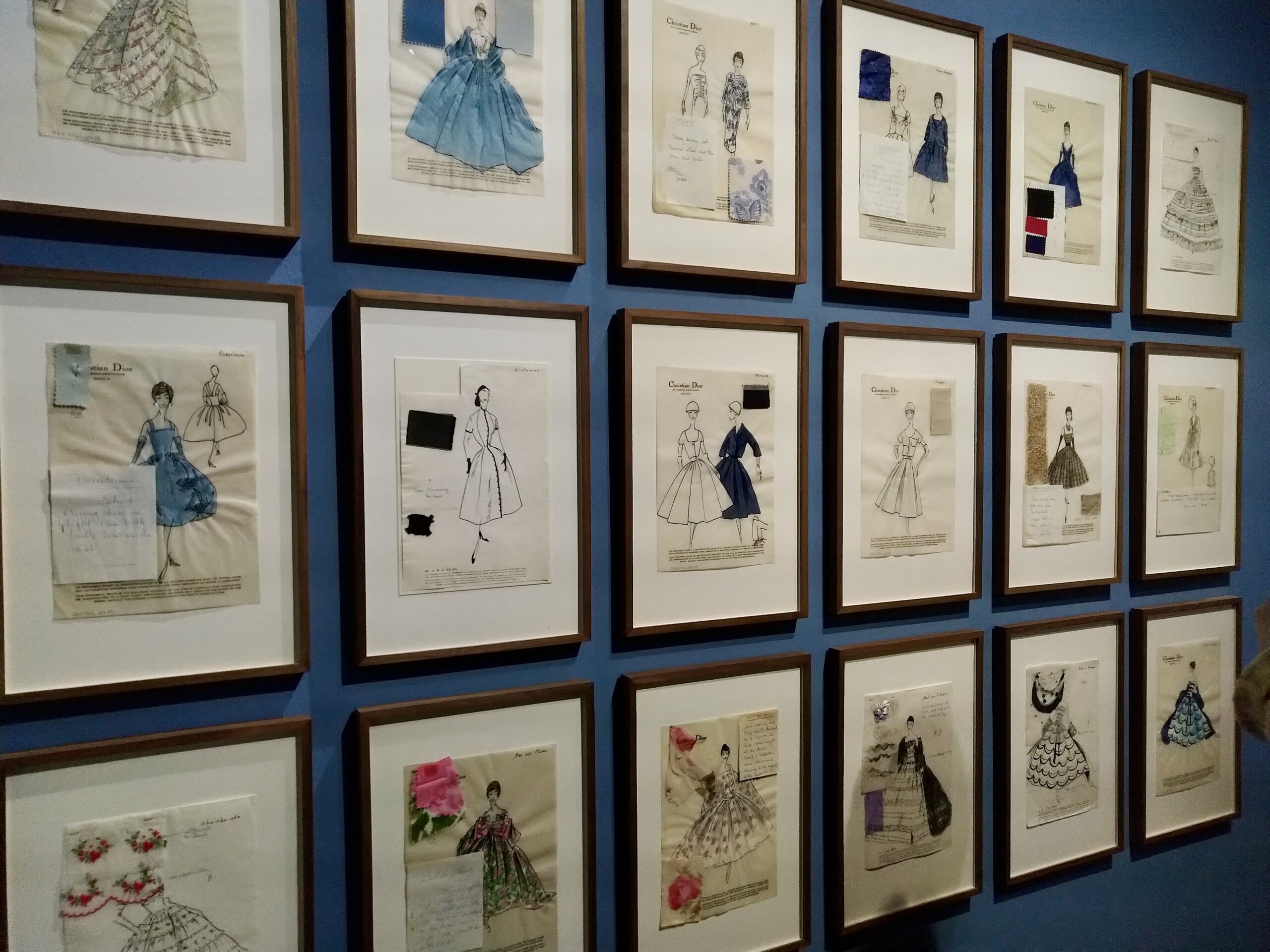
The featured image shows a collection of Christian Dior’s sketches for new fashion designs. Photo taken at the Dior exhibition in the Kunstmuseum, The Hague, February 2025.


Leave a Reply